Removing a clot from a vein sounds simple, but the tools that do it can leave damage behind. Conventional mechanical thrombectomy devices scrape, macerate, or drag thrombus along the vessel — and in doing so can abrade the vein wall and pull on the delicate one-way valves that keep blood moving in the right direction. In the deep veins of the leg, that collateral trauma is a real cost: damaged valves can lead to long-term problems well after the original clot is gone.
Principal Medical's atraumatic thrombectomy device is designed around a different idea — capture the clot without dragging against the vessel.
How it works
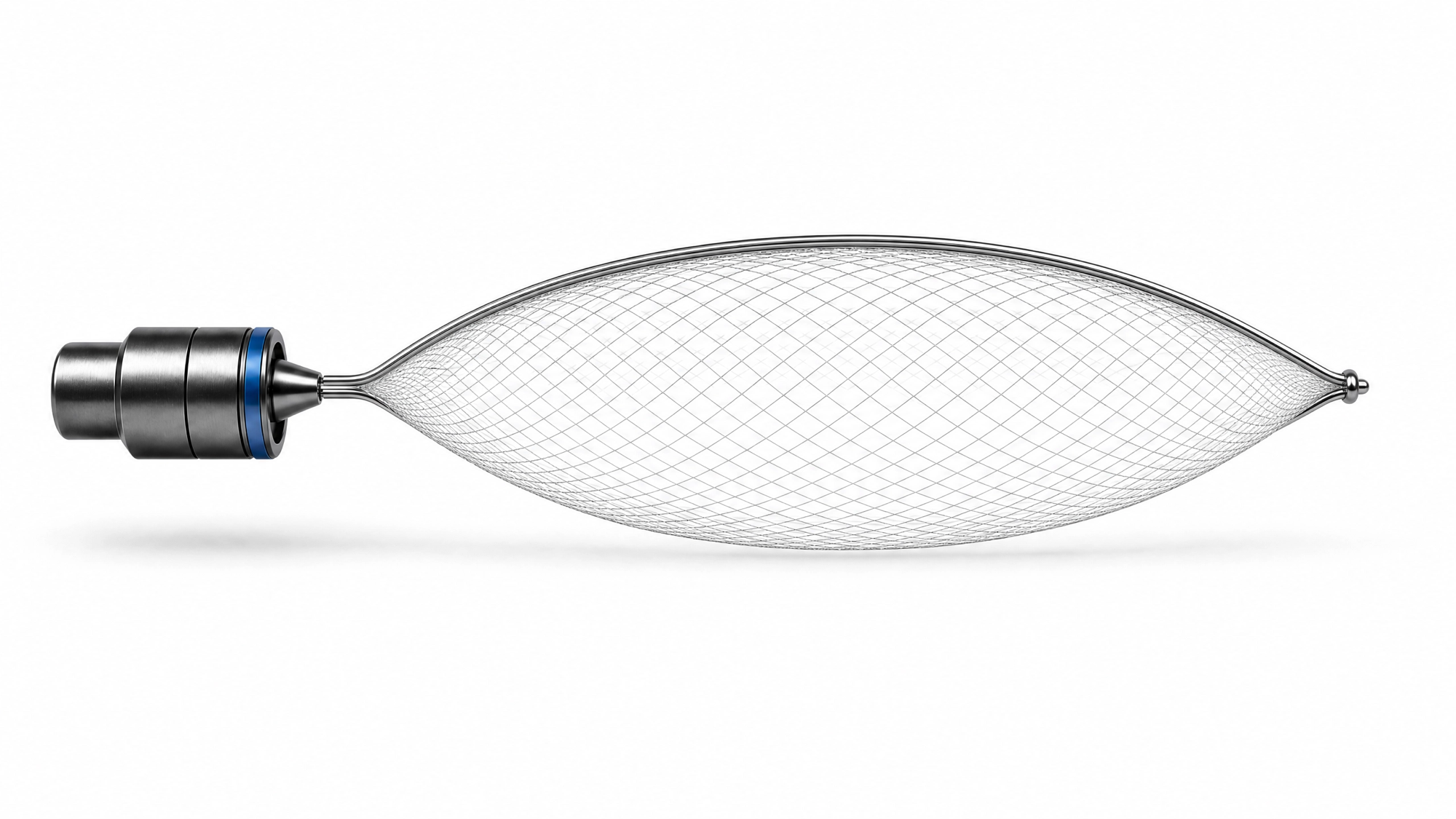
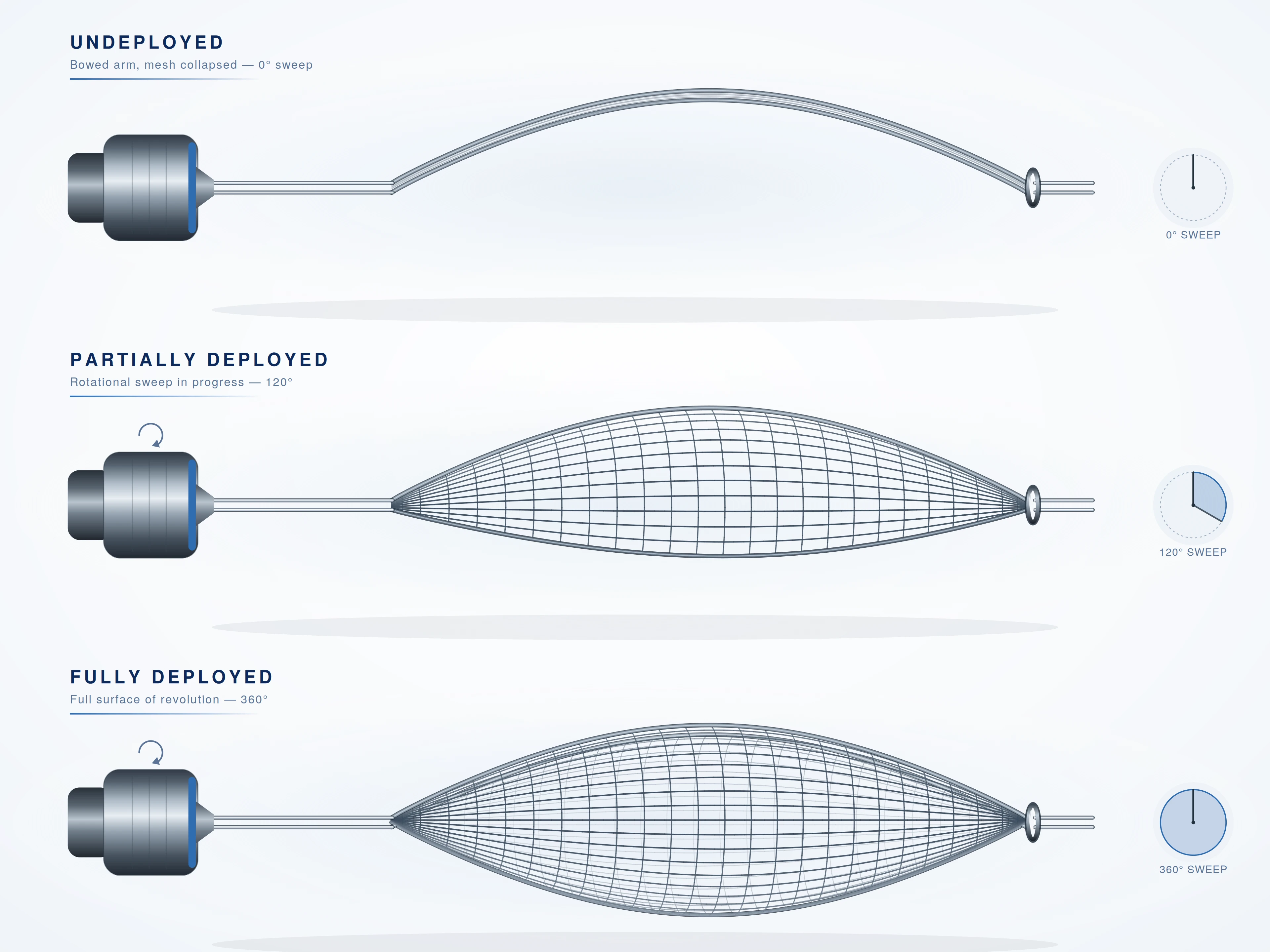
The device is built around a net carried on two rods, controlled from a handle that stays outside the patient. One rod is fixed; the second is coupled to a knob on the handle. The rods and net are advanced through a vessel-entry sheath to the site of the clot in a collapsed position, so nothing is deployed until the device is in place.
To capture the clot, the clinician turns the knob. The moving rod sweeps gently around the inside of the vessel, carrying the netting material along the vessel wall; a full rotation brings the rods back into opposition and closes the net around the thrombus. Rather than pushing or scraping the clot forward, the device is designed to encapsulate it. The whole apparatus — net and captured clot together — is then withdrawn through the original entry point.
How it protects the vein and its valves
Capturing a clot in a net and removing it whole is not, on its own, new. What makes this device atraumatic is how the net gets around the clot. Rather than being pushed across the thrombus and then pulled back — coring or dragging the clot along the vessel, and scraping the wall and valves on the way — the net is swept around the clot in place and closed over it. The device engages the clot from alongside it, encircles it, and lifts it out, rather than raking it back through the vein.
That protection is also built into the geometry. The two rods carry paired curved segments designed to face away from the vessel wall — concave outward — so that as the device is inserted, swept, and removed, it opposes the wall gently rather than digging into it. The intent is to net the clot "without creating abrasion on the walls of the veins or pressures pulling on the valves," so the device protects the vein and valves from the trauma that can accompany clot removal.
Design at a glance
- Capture element
- Braided net on paired rods
- Control
- Handle and knob, exterior to the patient
- Deployment
- Through a vessel-entry sheath, collapsed
- Capture
- Knob rotation opens the net around the clot
- Removal
- Net and clot withdrawn together, whole
An option to infuse where needed
A variant of the design uses a hollowed rod with side holes, so that thrombolytic medication can be delivered locally during the procedure — bringing clot-dissolving therapy to the site while the net is in place. It is one more way the platform is designed to fit how clinicians actually manage clot, rather than forcing a single approach.
Designed to work without crossing the clot
Perhaps the most consequential design goal is where the device does not have to go. Many thrombectomy tools have to be advanced past the thrombus — threaded distal to it — before they can engage and pull it back. This device is designed to work from a position at or proximal to the clot: the patent describes rods that are "positioned within or to the side of the clot," where a rotational sweep then closes the net around it in place. Nothing has to cross the thrombus first.
That difference matters most in exactly the places where crossing is difficult or impossible — where there is no safe landing zone beyond the clot to advance into:
- Branched and below-the-knee vessels — such as popliteal artery thrombus, where the anatomy beyond the clot may not accommodate a device.
- Proximal AV graft and fistula thrombus — dialysis-access clot at the arterial or venous anastomosis, where there is little room to work distal to the occlusion.
- Mid-to-distal IVC thrombus — large-vessel clot where advancing a device past it is neither easy nor desirable.
In each of these settings, being able to capture a clot from alongside it — rather than from beyond it — is designed to open up cases that are hard to address with tools that must cross the thrombus to work.
Investigational status: Principal Medical's portfolio platforms and the products referenced here are currently in development and are not yet cleared or approved by the U.S. Food and Drug Administration.